
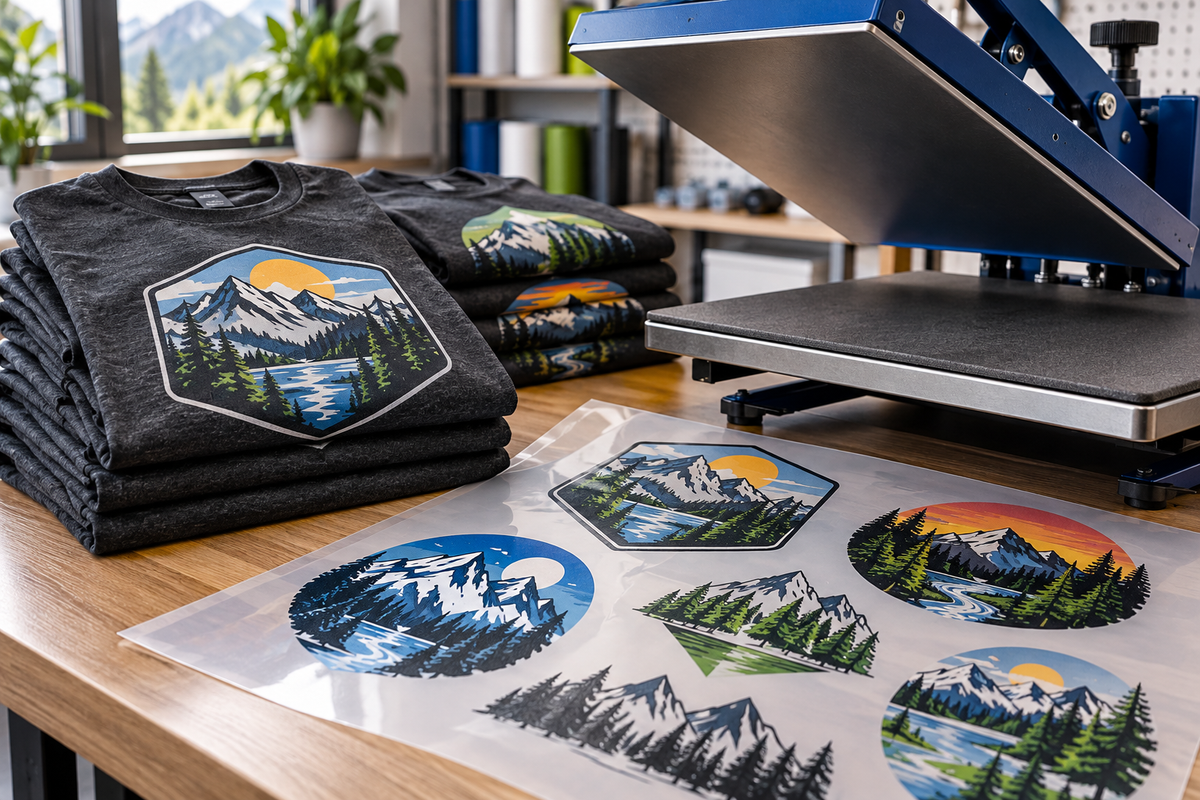
Cover image: illustrative decoration mockup.
The original order was 200 shirts. Now the customer needs six more—and wants them by Friday.
It is a familiar decision for a screen printing shop: set the job up again, fit it around scheduled production, or find another way to deliver. The order may be small, but how you handle it can matter to the next large order.
DTF transfers give you another production option. The useful question is where they fit your costs, your equipment, and the result your customer expects.
Start with the job, not a universal quantity rule
There is no single shirt count at which every shop should switch between DTF and screen printing. A one-color reorder with usable screens is a different calculation from a new multicolor design. A clear production schedule is different from a press already booked all week.
Compare the complete job: preparation, setup, printing or pressing, cleanup, and the time the order takes away from other work. Then consider print feel, coverage, placement, garment compatibility, and your customer's expectations.
Four situations worth quoting with DTF
1. Small reorders for established customers
A few new employees, replacement uniforms, or additional event shirts can create recurring work between larger orders. With ready-to-press transfers, you can plan those additions around your heat-press capacity.
If the original garments were screen printed, show the customer the proposed DTF result before promising an identical match. Different decoration methods can produce differences in appearance and feel.
2. Full-color artwork in short quantities
When a small order includes several colors, gradients, or detailed artwork, compare the preparation and setup required for each method. DTF may make the order easier to accommodate, but inspect the artwork at its actual print size. Tiny type and delicate details still need production judgment.
3. Rush work that would interrupt a longer run
A short job can occupy more than its share of a busy day. Outsourced transfers can move printing off your equipment while your team handles application. That only helps if transfer availability, garment arrival, and pressing capacity all fit the deadline.
4. Additional placements and mixed orders
A customer might need a front design, sleeve graphic, and different artwork for several teams. A gang sheet can group those transfers into one organized order. Keep the job quantities and placement instructions clear so efficiency at ordering does not become confusion at the press.
Compare cost per finished garment
For a DTF job, start with this calculation:
Transfer cost + allocated shipping + application labor + garment cost + an allowance for testing and spoilage = estimated production cost per finished garment.
Include handling time: separating transfers, loading garments, positioning artwork, peeling, the second press, and inspection. The heat-press timer alone is not your labor time.
For screen printing, include artwork preparation, screen work, setup, ink, production labor, cleanup, and garments. Use your own costs. A transfer price by itself cannot tell you which method produces the better margin.
Keep screen printing where it fits best
If a repeat design is efficient on your existing equipment, the run is economical, and the customer prefers the result, screen printing may remain the right choice. Test large solid designs and unusual placements before assuming a transfer will meet the same expectations.
The goal is to build a production mix that lets you accept worthwhile work and deliver it consistently.
Choose a transfer supplier that understands the shop floor
At DTF Experts, we use thousands of our own transfers daily in our contract-decorating production. We understand that a transfer order is usually one step in a larger customer deadline.
Our Premium DTF Transfers are our most popular offering for cotton and polyester apparel. CMYK + R G B O expanded-color printing is included. For selected coated or water-resistant garments, explore Strong Bond and test the exact garment before production.
Have a short run or reorder ready? Build a Premium DTF gang sheet, or upload your completed sheet.

Leave a comment
This site is protected by hCaptcha and the hCaptcha Privacy Policy and Terms of Service apply.